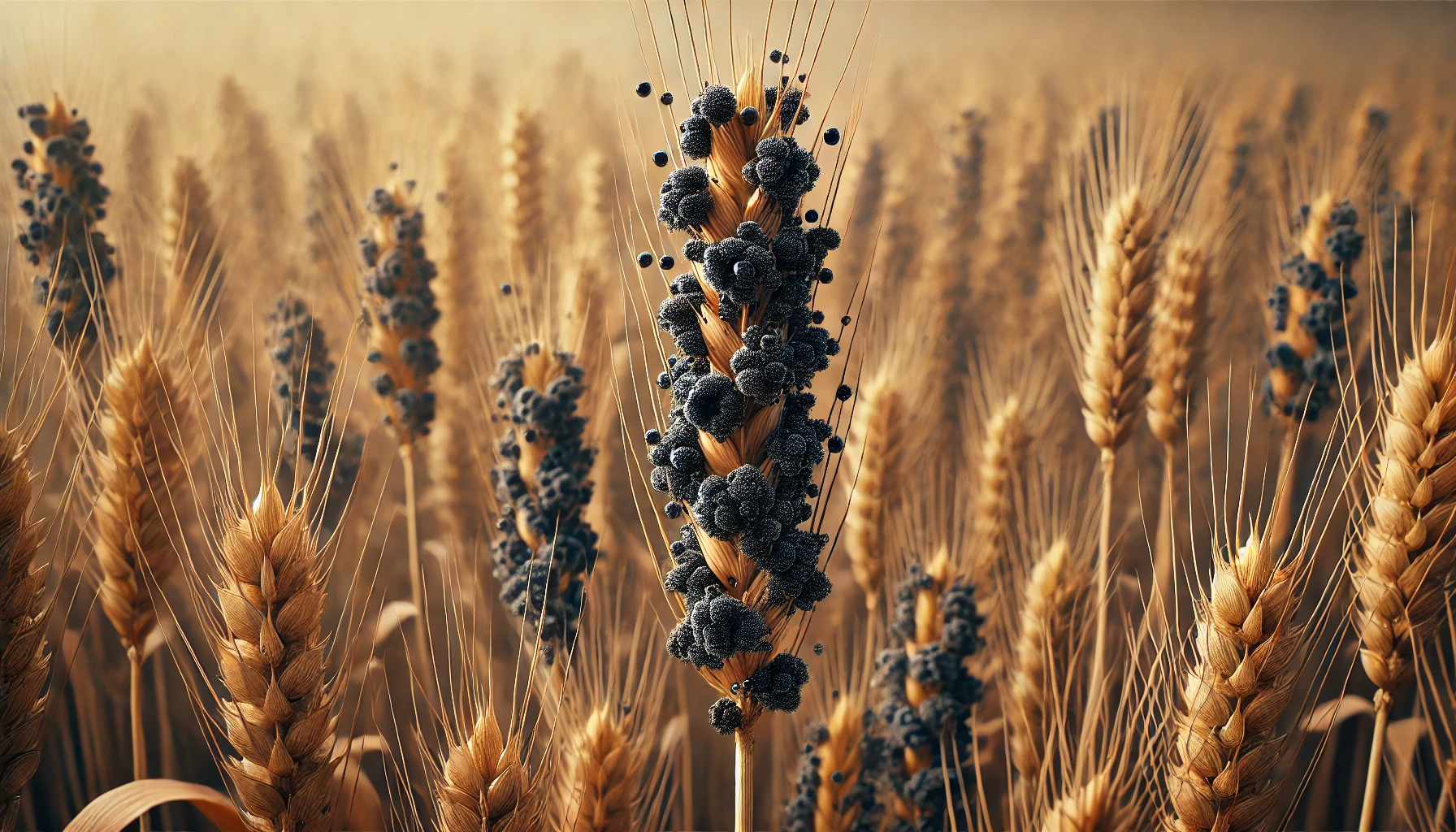

Wheat (Triticum aestivum) is one of Nepal’s key staple crops, playing a critical role in national food security. However, the production of wheat is continuously threatened by various seed-borne diseases, one of the most devastating being Loose Smut caused by the fungus Ustilago tritici. Loose smut can cause significant yield losses in wheat crops across Nepal, particularly in areas where farmers rely heavily on seed-saving practices and lack access to disease-resistant varieties or fungicides.
This blog post provides an in-depth, scientific overview of the disease cycle of loose smut in wheat and highlights effective control measures suitable for Nepal’s agricultural context.
1. Understanding Loose Smut of Wheat
Loose smut is an internally seed-borne fungal disease that specifically affects wheat. It is caused by the pathogen Ustilago tritici and is characterized by the transformation of wheat grains into black, powdery masses of fungal spores. These smutted grains fail to produce healthy seeds, leading to significant yield loss. In the context of Nepal, where wheat is grown widely across the Terai plains, the mid-hills, and some higher altitude regions, controlling loose smut is critical to maintaining wheat productivity.
Ustilago tritici is a pathogenic fungus that causes loose smut in wheat (Triticum aestivum). As a seed-borne pathogen, it is responsible for significant yield losses in wheat-growing regions worldwide, including Nepal. Understanding the biology and characteristics of Ustilago tritici is crucial for managing the disease it causes.
| Kingdom | Fungi |
| Phylum | Basidiomycota |
| Class | Ustilaginomycetes |
| Order | Ustilagiales |
| Family | Ustilaginaceae |
| Genus | Ustilago |
| Species | Ustilago tritici |
Ustilago tritici is characterized by its production of teliospores, which are the primary means by which the fungus spreads and survives. These teliospores are:
- Round to oval in shape.
- Dark brown to black in color.
- Measuring 5-9 µm in diameter.
Produced in large quantities within the wheat spikelets, replacing the wheat grains with a powdery mass of spores.
The life cycle of Ustilago tritici is complex, involving several stages of reproduction, both sexual and asexual. The fungus follows a biotrophic lifestyle, meaning it lives within a host plant and requires living tissue to complete its life cycle.
Systemic Growth: As the infected seedling develops, the fungus grows systemically through the plant tissues, eventually reaching the developing spikelets (ears). At this stage, instead of healthy grains, the spikelets are filled with teliospores, which are then dispersed to new plants.
Teliospores: These spores are produced in infected wheat plants and are dispersed by wind or rain. The teliospores are the dormant, overwintering stage that allows the fungus to survive outside of a host.
Germination: When conditions are favorable (typically during wheat flowering), teliospores germinate to produce basidiospores. Each teliospore produces a basidium that gives rise to several basidiospores.
Infection: Basidiospores land on wheat flowers and initiate infection. The basidiospores fuse to form a dikaryotic mycelium (having two nuclei), which enters the wheat ovary and infects the developing seed. The fungus grows inside the embryo, but the infected seed appears normal on the outside.
Latent Phase: The fungus remains dormant within the seed’s embryo until the following growing season when the seed is sown. Once the seed germinates, the fungus becomes active and grows along with the wheat plant.
- Host Specificity: Ustilago tritici infects mainly wheat species, including common wheat (Triticum aestivum) and durum wheat (Triticum durum). The fungus is highly specialized and infects the host systemically.
- Infection Time: The fungus infects wheat plants during the flowering stage (anthesis), entering through the open florets. This timing is crucial for the fungus to access the developing wheat ovary.
- Symptom Expression: Symptoms of infection are not visible until the plant reaches the heading stage, when the smutted wheat heads appear. This delay in symptom development makes early detection of the disease challenging.
2. Disease Cycle of Loose Smut in Wheat
The pathogens responsible for loose smut in wheat survive the winter as dormant mycelium within the scutellum of the cotyledon in infected seeds. When these seeds are sown and begin to germinate, the dormant mycelium reactivates, growing between the cells (intercellular growth) of the young seedling until it reaches the plant’s growing point. The mycelium continues to develop along with the plant, while the hyphae in the lower stem tissues often disappear. As the wheat forms its head, the mycelium spreads throughout the young spikelets, invading and destroying most of the spike tissue, except for the rachis. Infected plants often grow slightly taller than healthy ones due to the pathogen’s stimulatory effect. The mycelium in the infected kernels eventually transforms into teliospores, which are enclosed by a thin membrane of host tissue. When mature, the membrane bursts, releasing the teliospores, which are dispersed by wind to nearby healthy plants. Spore release occurs around the same time as the flowering of healthy plants. When teliospores land on flowers, they germinate by producing a basidium, which gives rise to haploid hyphae. After the fusion of compatible haploid hyphae, the resulting dikaryotic mycelium penetrates the flower through the stigma or young ovary walls and establishes itself in the pericarp and embryo tissues before the kernel matures. The mycelium then becomes dormant in the scutellum, awaiting the next germination cycle.
The disease cycle of Ustilago tritici is intricate, and understanding each stage is essential for developing control measures.
a. Primary Infection during Flowering
The disease begins when fungal teliospores, produced from previously infected plants, land on the wheat flowers during the anthesis (flowering) stage. These spores are carried by wind or rainwater, facilitating the spread across fields. In Nepal’s wheat-growing regions, flowering typically occurs during late winter or early spring, creating ideal conditions for fungal spread due to moderate temperatures and occasional humidity.
Upon landing on the wheat flowers, the teliospores germinate and release basidiospores, which then produce hyphae that penetrate the wheat ovary. It’s at this stage that the plant is systemically infected, but symptoms do not immediately manifest. The fungus remains latent within the embryo of the developing wheat grain.
b. Dormancy in Seed
After the infection, the pathogen becomes dormant within the wheat seed’s embryo. This dormant phase is significant because the infected seeds appear completely normal from the outside. The infected seed is often saved by farmers for the next planting season, unknowingly propagating the disease. This practice is common in Nepal, especially in rural areas where access to certified seeds is limited.
c. Seed Germination and Systemic Infection
When an infected seed is sown in the next season, the fungus reactivates during seed germination. As the wheat seed sprouts, the fungal mycelium grows systemically along with the plant, infiltrating the growing points, including the stem and leaves.
d. Smutting and Spore Dispersal
The most noticeable symptoms of loose smut become evident when the wheat heads (spikes) emerge during the plant’s reproductive stage. Instead of normal grains, infected plants produce black, powdery masses of teliospores that completely replace the spikelets. These teliospores are easily dispersed by wind and water, infecting new plants during the flowering stage and perpetuating the disease cycle.
In Nepal’s wheat fields, this phase typically coincides with the pre-monsoon period, where weather conditions—such as light rain and wind—are conducive to the dispersal of the smut spores.
3. Symptoms of Loose Smut in Wheat
Farmers in Nepal should be aware of the key symptoms associated with loose smut to detect the disease early and prevent its spread. The primary symptoms include:
- Early Plant Maturity: Infected plants often mature earlier than healthy plants but produce no viable grain.
- Smutted Wheat Heads: Infected spikelets are replaced by black, powdery fungal spores instead of healthy grains.
- Brittle Heads: Smutted heads tend to be fragile and break apart easily, releasing spores into the environment.
4. Factors Favoring Loose Smut Development in Nepal
Several factors contribute to the prevalence of loose smut in wheat crops across Nepal:
- Seed-Saving Practices: In rural farming communities of Nepal, the use of saved seeds from the previous harvest is common. If these seeds are infected with Ustilago tritici, the disease will persist from one season to the next.
- Environmental Conditions: Wheat in Nepal is typically grown during the winter season. The mild, temperate climate of the flowering period (15°C to 25°C) provides an ideal environment for fungal infection. Additionally, occasional rainfall during this period aids in the spread of spores.
- Limited Use of Resistant Varieties: While disease-resistant wheat varieties are available, their adoption has been slow due to limited awareness and availability in many parts of Nepal.
5. Effective Control Measures for Loose Smut in Nepal
It is essential to confirm the presence of dormant mycelium in the wheat seed before proceeding to control measures, one of the easiest method is Examination of Whole Embryo.
This method is employed to detect obligate pathogens such as Ustilago hordei and Ustilago tritici (responsible for loose smut in barley and wheat). Seeds are immersed overnight in a 10% sodium hydroxide solution with trypan blue stain at 25°C. They are then rinsed with warm water using a series of sieves with decreasing mesh sizes. The embryos are finally treated with lactophenol to clear them. Under a stereomicroscope, infected embryos display bluish-stained mycelium, which can be found in the scutellum, plumule bud, or throughout the embryo.
Controlling loose smut in wheat requires an integrated approach that includes the use of certified seeds, chemical treatments, and proper agronomic practices. Below are the most effective control strategies for managing loose smut in Nepal.
a. Use of Certified Disease-Free Seeds
The most important and effective control measure is to use certified, disease-free seeds. These seeds are tested to ensure that they are free of loose smut pathogens. In Nepal, government initiatives and agricultural cooperatives play a critical role in making certified seeds available to farmers. Switching from saved seeds to certified seeds can significantly reduce the risk of loose smut outbreaks.
b. Hot Water Treatment
The hot-water treatment involves a sequence of steps to treat seeds for disease control. First, the seeds are soaked in 20°C water for five hours while contained in partially filled burlap bags. After draining the seeds for one minute, they are immersed in 49°C water for approximately one minute, followed by immersion in 52°C water for exactly 11 minutes. Immediately afterward, the seeds are cooled by placing them in cold water. Once cooled, the seeds are dried and prepared for sowing. Since some seeds may not survive the heat treatment, a higher seeding rate is recommended to compensate for the potential reduction in germination viability.
c. Fungicide Seed Treatment
Chemical seed treatments are highly effective at controlling loose smut in wheat. Fungicides such as carboxin, tebuconazole, or difenoconazole can be applied to wheat seeds before planting to eliminate the dormant pathogen within the seed embryo. These fungicides penetrate the seed coat and prevent the systemic infection of the plant during germination.
In Nepal, promoting seed treatment through agricultural extension programs can help farmers in remote areas understand the benefits of fungicide application and how to perform it effectively.
d. Use of Smut-Resistant Wheat Varieties
Nepal has been actively involved in the development and promotion of disease-resistant wheat varieties through the efforts of the Nepal Agricultural Research Council (NARC) and other research bodies. Smut-resistant varieties have been bred to resist Ustilago tritici infection, significantly reducing the disease incidence. By adopting these varieties, farmers can ensure a natural defense against the pathogen without relying heavily on chemical inputs.
e. Crop Rotation and Sanitation
Implementing crop rotation by alternating wheat with non-host crops such as legumes or oilseeds can help reduce the pathogen load in the soil. Additionally, maintaining good field hygiene—such as removing infected plant debris, cleaning tools, and destroying infected plants—can prevent the disease from spreading to healthy plants.
f. Awareness and Training Programs
In Nepal, where the majority of farmers are smallholders with limited access to agricultural education, awareness programs are crucial. Agricultural extension services can play a vital role in teaching farmers about the disease, its symptoms, and how to prevent its spread. By working with cooperatives, NGOs, and local governments, awareness programs can promote the importance of using certified seeds, seed treatments, and resistant varieties.
6. Conclusion
Loose smut of wheat poses a significant challenge to wheat production in Nepal, particularly in areas where traditional farming practices and limited access to certified seeds are prevalent. Understanding the disease cycle of Ustilago tritici is key to developing effective control strategies. By adopting integrated pest management approaches—including the use of certified disease-free seeds, fungicide treatments, smut-resistant varieties, and proper field sanitation—Nepali farmers can protect their wheat crops from devastating yield losses.
Increased government support, awareness campaigns, and access to agricultural inputs will play a critical role in mitigating the effects of loose smut on wheat production in Nepal, ensuring better harvests and improved food security across the country.