Brown rust of wheat, also known as leaf rust, is a significant wheat disease caused by the fungus Puccinia triticina (formerly Puccinia recondita). In Nepal, where wheat is the third most important cereal crop after rice and maize, this disease poses a serious threat to agricultural productivity, affecting both yield and grain quality. The disease has been observed across wheat-growing regions, especially in the mid-hills and Terai belt, where favorable climatic conditions—such as moderate temperatures and high humidity—support the growth and spread of the pathogen.
This blog provides an in-depth analysis of brown rust of wheat, focusing on its impact in Nepal. It will explore the disease cycle, symptoms, and management practices to help farmers and agricultural practitioners mitigate the problem and ensure food security.
Understanding Brown Rust of Wheat
Brown rust of wheat, or leaf rust, is caused by the fungal pathogen Puccinia triticina. This pathogen specifically infects the leaves of wheat plants, forming small brown pustules on the leaf surface. The disease can rapidly spread in warm, moist conditions, which are common during the wheat-growing season in Nepal.
Characteristics of Puccinia triticina
Puccinia triticina is an obligate parasite, meaning it requires living host tissue to survive and reproduce. The fungus primarily infects wheat plants but can also infect certain species of wild grasses. Once the pathogen establishes itself in a field, it can produce numerous spores that disperse through wind, rain, or irrigation systems, enabling the disease to spread to nearby plants or fields.
Climatic Conditions Favoring Brown Rust of Wheat in Nepal
Brown rust of wheat thrives under specific climatic conditions:
- Temperature: The fungus develops optimally at temperatures between 15°C and 22°C, which is typical during the wheat-growing season in the Terai and mid-hill regions of Nepal.
- Humidity: High humidity, especially after rainfall or irrigation, creates a conducive environment for spore germination and infection.
- Wind: Spores are wind-dispersed, which allows the disease to spread rapidly over large areas.
- Rainfall: Rain splashes help in spreading the spores from one plant to another.
In Nepal, these conditions often align during critical stages of wheat growth, making the disease a persistent issue for farmers in many regions.
Symptoms of Brown Rust of Wheat
Recognizing the symptoms of brown rust of wheat early is essential for timely disease management. The following are the most common symptoms:
- Brown Pustules (Uredinia): Small, circular, orange-brown pustules (known as uredinia) appear on the upper surface of the leaves. These pustules contain urediniospores, the reproductive structures of the fungus, which allow the disease to spread.
- Leaf Damage: The infected leaves may turn yellow and die prematurely, reducing the plant’s photosynthetic ability, which directly affects grain filling and overall yield.
- Pustule Density: In severe infections, pustules may cover large portions of the leaf, leading to necrosis and leaf drop.
- Grain Quality: If the disease reaches the flag leaf (the uppermost leaf), it severely impacts the plant’s ability to produce high-quality grain, resulting in shriveled and lightweight kernels.
Disease Cycle of Brown Rust of Wheat
Puccinia triticiana has a heteroecious, macrocyclic life cycle, meaning it requires two different host plants to complete its life cycle and produces five distinct types of spores. The two hosts involved are wheat (Triticum aestivum) and an alternate host, often species from the Thalictrum genus or similar plants. Understanding the complete disease cycle is essential for controlling this disease and minimizing crop losses.
The five spore stages are urediniospores, teliospores, basidiospores, spermatia (pycniospores), and aeciospores. Below is a detailed breakdown of the brown rust of wheat disease cycle and the role each spore type plays.
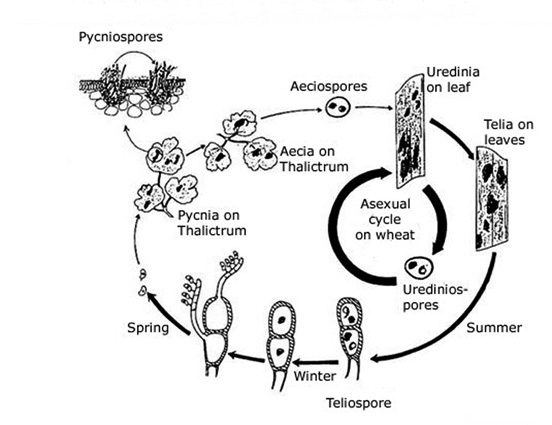
Source: TNAU Agritech Portal
1. Urediniospores: The Primary Infective Stage
The urediniospore stage is central to the rapid spread and epidemic development of wheat leaf rust during the growing season. These spores are dikaryotic (contain two haploid nuclei) and are produced in large quantities from uredinia, the orange-brown pustules that appear on the wheat leaves.
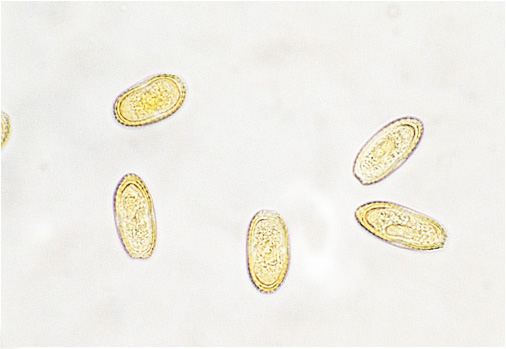
Source: TNAU Agritech Portal
Key Characteristics:
- Dispersal: Urediniospores are wind-borne and can travel over vast distances, spreading the infection across large areas.
- Infection: Urediniospores land on the surface of wheat leaves and, under favorable conditions (moisture and temperatures of 15-22°C), germinate. The germ tube produced by the urediniospore seeks out a stomatal opening to enter the leaf. Once inside, the fungus develops haustoria, which penetrate plant cells and extract nutrients.
- Reproduction: The fungus continuously produces more urediniospores throughout the growing season, allowing for multiple cycles of infection and rapid disease spread.
The urediniospore stage is crucial for the pathogen’s epidemic development and is responsible for the characteristic rust symptoms on wheat leaves.
2. Teliospores: Survival and Sexual Reproduction
As the wheat plant matures and environmental conditions become less favorable for urediniospore production, Puccinia triticina shifts to the production of teliospores. Teliospores are thick-walled, black spores that serve primarily as a survival structure, allowing the pathogen to overwinter.
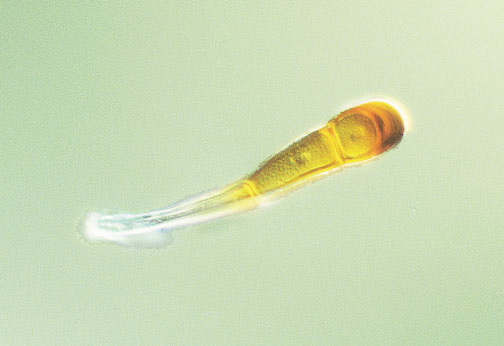
Source: TNAU Agritech Portal
Key Characteristics:
- Formation: Teliospores are produced within the same pustules as urediniospores during the later stages of the growing season. They are dikaryotic and develop into diploid cells after karyogamy (nuclear fusion).
- Overwintering: Teliospores are highly resistant to environmental stresses, such as cold temperatures, and can survive on crop residues or in the soil over the winter. They do not infect wheat directly.
- Germination: In the spring, teliospores germinate to produce basidiospores, which initiate the sexual stage of the pathogen’s life cycle.
The teliospore stage is critical for the pathogen’s survival between growing seasons and for enabling genetic recombination during sexual reproduction.
3. Basidiospores: Sexual Recombination and Infection of the Alternate Host
Once teliospores germinate, they produce basidia, specialized structures that undergo meiosis to form haploid basidiospores. This marks the beginning of the sexual phase of the pathogen’s life cycle.
Key Characteristics:
- Genetic Recombination: During meiosis, genetic recombination occurs, creating new genetic variations in the pathogen population. This allows Puccinia triticina to adapt to different environmental conditions and overcome host plant resistance.
- Alternate Host Infection: Basidiospores are small, fragile spores that cannot infect wheat directly. Instead, they infect the alternate host (such as Thalictrum species), where the next stage of the life cycle occurs. Basidiospores penetrate the alternate host’s leaf tissue and initiate the formation of structures called spermagonia (pycnia).
The basidiospore stage facilitates sexual reproduction and contributes to the pathogen’s genetic diversity.
4. Spermatia (Pycniospores): Sexual Reproduction on the Alternate Host
After basidiospores infect the alternate host, spermatia (also known as pycniospores) are produced in structures called spermagonia (pycnia), which develop on the upper side of the alternate host’s leaves.

Source: Wikipedia
Key Characteristics:
- Mating: Spermatia are haploid spores that function in sexual reproduction. They are non-infective and do not directly contribute to the spread of the disease. Instead, they are involved in the fertilization process.
- Recombination: Fertilization occurs when spermatia from one mating type combine with receptive hyphae (also known as flexuous hyphae) of the opposite mating type, leading to the formation of dikaryotic cells. These dikaryotic cells then give rise to aecia on the alternate host.
The spermatia stage is important for completing the sexual reproduction phase of the pathogen’s life cycle.
5. Aeciospores: Return to Wheat and New Infections
Once fertilization occurs, dikaryotic aecia form on the lower side of the alternate host’s leaves, producing aeciospores. Aeciospores are dikaryotic and capable of infecting wheat, thereby completing the pathogen’s life cycle.

Source: Wikipedia
Key Characteristics:
- Infecting Wheat: Aeciospores are wind-dispersed and return to wheat plants, where they cause new infections. The aeciospores infect wheat leaves by germinating and producing germ tubes that enter the plant through the stomata, just as urediniospores do.
- Establishment of Uredinial Stage: Once aeciospores infect wheat, the fungus transitions back to producing uredinia and urediniospores, starting a new cycle of asexual reproduction.
The aeciospore stage is crucial for reinfecting wheat and continuing the disease cycle.
Summary of the Disease Cycle
The full disease cycle of wheat leaf rust can be summarized as follows:
- Urediniospores infect wheat, causing rapid spread and multiple infection cycles throughout the growing season.
- Teliospores are produced late in the season for overwintering and eventual sexual reproduction.
- Basidiospores are formed from teliospores after meiosis, infecting the alternate host.
- Spermatia (pycniospores) facilitate sexual reproduction on the alternate host.
- Aeciospores return to wheat, initiating new infections and completing the cycle.
Importance of Each Spore Stage in Disease Management
- Urediniospores: Effective fungicide application can prevent the rapid spread of urediniospores.
- Teliospores: Managing crop residues can reduce the survival of teliospores and break the disease cycle.
- Basidiospores, Spermatia, and Aeciospores: The sexual phase, which typically involves an alternate host, is less common in many wheat-growing regions. However, removing or managing alternate hosts can reduce opportunities for genetic recombination, limiting the development of new, virulent rust strains.
Management Practices for Brown Rust of Wheat in Nepal
Effective management of brown rust of wheat requires an integrated approach, combining cultural practices, resistant wheat varieties, chemical control, and biological measures. The following strategies have proven effective in managing brown rust in Nepal.
1. Use of Resistant Varieties
The most effective and economical method for managing brown rust of wheat is the use of resistant wheat varieties. Plant breeders in Nepal and other countries have developed wheat cultivars that are resistant to specific races of Puccinia triticina. Some of the rust-resistant varieties grown in Nepal include:
- Gautam: Known for its resistance to multiple rust diseases, including brown rust.
- WK 1204: A high-yielding wheat variety resistant to brown rust, commonly cultivated in the Terai region.
- BL 4341: This variety shows moderate resistance to brown rust and is suitable for mid-hill areas.
Farmers should regularly consult agricultural extension services for updates on new resistant varieties, as rust pathogens can evolve new races that overcome plant resistance.
2. Cultural Practices
Several cultural practices can reduce the severity and spread of brown rust. These include:
- Crop Rotation: Rotating wheat with non-host crops like maize or legumes helps break the disease cycle and reduces the buildup of rust spores in the field.
- Early Sowing: Sowing wheat early in the season helps avoid peak periods of rust infection, as the plants will be at a more mature stage during times of high rust pressure.
- Removal of Volunteer Wheat: Volunteer wheat plants (those growing from seed left over from the previous crop) can harbor the rust fungus, so they should be removed to reduce the inoculum source.
- Field Sanitation: Proper disposal of crop residues through burning or deep plowing reduces the chance of overwintering rust spores.
3. Chemical Control
When rust pressure is high, fungicides can be an effective tool for controlling brown rust. The use of fungicides, however, should be carefully managed to avoid the development of fungicide resistance. Commonly used fungicides in Nepal include:
- Triazoles: Such as Tebuconazole and Propiconazole, which inhibit fungal growth by targeting the sterol biosynthesis pathway.
- Strobilurins: Such as Azoxystrobin, which prevent fungal respiration and spore germination.
- Chlorothalonil: A broad-spectrum fungicide used in combination with other chemicals to enhance efficacy.
Fungicides should be applied at the onset of symptoms or when weather conditions are favorable for disease development (i.e., periods of high humidity and moderate temperatures). It is advisable to rotate fungicides with different modes of action to delay the development of resistance.
4. Biological Control
Though not widely practiced, biological control offers a sustainable alternative to chemical fungicides. Certain biological agents, such as Trichoderma species, can antagonize rust fungi by competing for space and nutrients or producing antifungal compounds. In Nepal, the use of biological control is still in its infancy, but research is ongoing to explore its potential for managing wheat rusts.
5. Monitoring and Early Detection
Regular monitoring of wheat fields is critical for early detection of rust outbreaks. Farmers should scout their fields frequently, especially during periods of high humidity and moderate temperatures, to spot the first signs of rust pustules. Early detection allows for timely intervention, whether through the application of fungicides or other control measures.
6. Extension Services and Farmer Education
Agricultural extension services play a vital role in helping farmers manage wheat rusts. In Nepal, government agencies and NGOs organize training programs to educate farmers about disease identification, resistant varieties, and integrated pest management (IPM) strategies. Farmers should take advantage of these programs to stay informed about the latest rust management practices.
Impact of Brown Rust on Wheat Production in Nepal
Brown rust has a profound impact on wheat production in Nepal, especially in areas where resistant varieties are not available or cultural practices are not adequately followed. Infected plants exhibit reduced grain fill, leading to lower yields and poorer grain quality. Severe infections, especially those affecting the flag leaf, can cause yield losses of up to 40%, depending on the variety and environmental conditions.
Furthermore, the cost of managing brown rust through chemical fungicides can place a financial burden on smallholder farmers, who may not have the resources to purchase expensive inputs. This underscores the need for a holistic, integrated approach to rust management that combines resistant varieties, cultural practices, and, when necessary, fungicide applications.
Conclusion
Brown rust of wheat remains a significant challenge for farmers in Nepal, but with proper management, its impact can be minimized. By adopting an integrated approach that includes resistant varieties, cultural practices, and judicious use of fungicides, farmers can protect their crops and ensure sustainable wheat production. Ongoing research and farmer education are also crucial in developing and disseminating new strategies to combat this disease. By working together, farmers, researchers, and policymakers can mitigate the effects of brown rust and safeguard Nepal’s wheat production for future generations.
For more information on how to manage wheat diseases and improve your crop yield, be sure to reach out to local agricultural extension offices or stay updated with the latest research on brown rust management.