
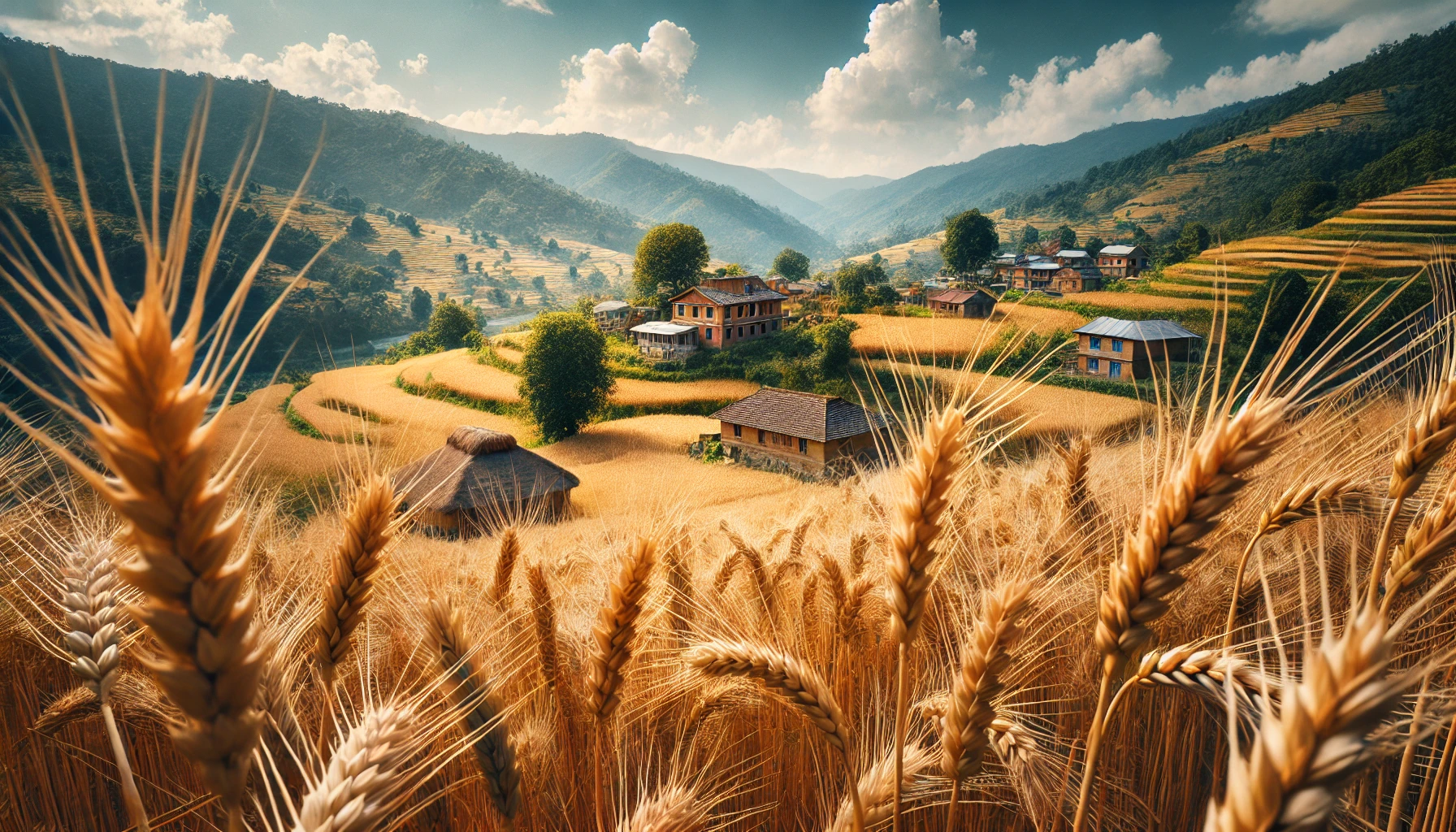

Wheat is a critical staple crop in Nepal, feeding millions and supporting the livelihoods of many rural farmers. However, this important cereal is susceptible to a variety of diseases, with black rust, also known as stem rust, being one of the most destructive. Black rust of wheat, caused by the fungal pathogen Puccinia graminis f. sp. tritici, has the potential to cause devastating yield losses, threatening food security in Nepal. Understanding the disease’s epidemiology, pathogenicity, disease cycle, and management practices is essential to protect wheat crops in Nepal from this significant threat.
This blog post presents a scientific overview of black rust of wheat, with a particular focus on its impact on Nepalese agriculture, and offers detailed management strategies to mitigate its effects.
Taxonomical Classification of Black Rust of Wheat Fungi
| Taxonomic Rank | Classification |
|---|---|
| Kingdom | Fungi |
| Phylum | Basidiomycota |
| Class | Agaricomycetes |
| Order | Pucciniales |
| Family | Pucciniaceae |
| Genus | Puccinia |
| Species | Puccinia graminis |
| Forma Specialis | Puccinia graminis f. sp. tritici |
Climatic Conditions Favoring Black Rust of Wheat
Black rust of wheat (Puccinia graminis f. sp. tritici) thrives under specific climatic conditions that accelerate the growth, spread, and infection capacity of the pathogen. The key factors that favor the development and proliferation of black rust include:
- Temperature:
- Optimal temperatures for black rust of wheat development range between 15°C and 30°C.
- Daytime temperatures around 20-25°C favor spore germination and infection.
- Nighttime temperatures above 10°C support the rapid development of pustules on wheat plants.
- Humidity:
- High humidity (above 60%) is crucial for spore germination.
- Prolonged periods of leaf wetness (due to dew or rain) promote the successful establishment of the fungus on plant surfaces.
- Wet conditions for 6-8 hours are typically needed for the urediniospores to infect wheat leaves and stems.
- Moisture:
- Frequent rainfall or heavy dew aids in the spread and survival of spores.
- Areas with high moisture levels, such as the Terai region of Nepal, provide ideal conditions for black rust outbreaks.
- Wind:
- Strong winds help disperse the spores (urediniospores) over long distances, facilitating the rapid spread of the disease across large wheat-growing areas.
- Wheat Growth Stage:
- Black rust typically infects wheat during the late growth stages (booting, heading, and grain-filling stages) when plants are more vulnerable.
In the context of Nepal, the Terai region and parts of the Mid-Hills often experience these favorable climatic conditions during the wheat-growing season, making these areas more susceptible to black rust outbreaks.
Symptoms of Black Rust of Wheat
Black rust, or stem rust of wheat, caused by Puccinia graminis f. sp. tritici, manifests in various ways throughout the growth cycle of wheat plants. Recognizing these symptoms early is crucial for managing the disease and minimizing yield losses. Key symptoms include:
- Pustules (Uredinia):
- Reddish-brown, oval, or elongated pustules appear primarily on stems, leaf sheaths, and leaves.
- These pustules contain masses of urediniospores, which are responsible for spreading the disease.
- The pustules can sometimes appear on grains and spikes but are most common on stems and leaves.
- Pustule Rupture:
- This gives the characteristic ragged appearance to infected tissues.
- As the disease progresses, the pustules rupture the epidermis of the plant, exposing the spore masses.
- Black Pustules (Telia):
- Toward the end of the wheat-growing season, the color of the pustules changes to black as the fungus produces teliospores (survival spores).
- These black telia are indicative of late-stage infection and are typically seen on the lower parts of the stems and leaves.
- Weakening of Stems:
- Infected stems often become weak, leading to lodging (plants collapsing before maturity), especially under windy or heavy rain conditions.
- This can cause reduced grain filling and significant yield loss.
- Premature Plant Death:
- Severe infections can lead to early senescence (premature death) of the plant.
- The plant’s ability to photosynthesize is severely impaired due to the pustules covering leaf surfaces.
- Grain Shriveling:
- In cases of severe infection, grain development is affected, leading to poor grain quality and shriveling.
- Impact on Yield:
- Infected plants exhibit stunted growth and weakened structural integrity, resulting in considerable yield losses if the disease is not controlled early.
Disease Cycle of Black Rust of Wheat
Black rust of wheat has a heteroecious, macrocyclic lifecycle posing a complex process involving both asexual and sexual reproduction. This pathogen primarily affects wheat and requires an alternate host, barberry (Berberis vulgaris), to complete its life cycle. The cycle consists of multiple spore stages, each serving a specific function in infection, reproduction, and survival.
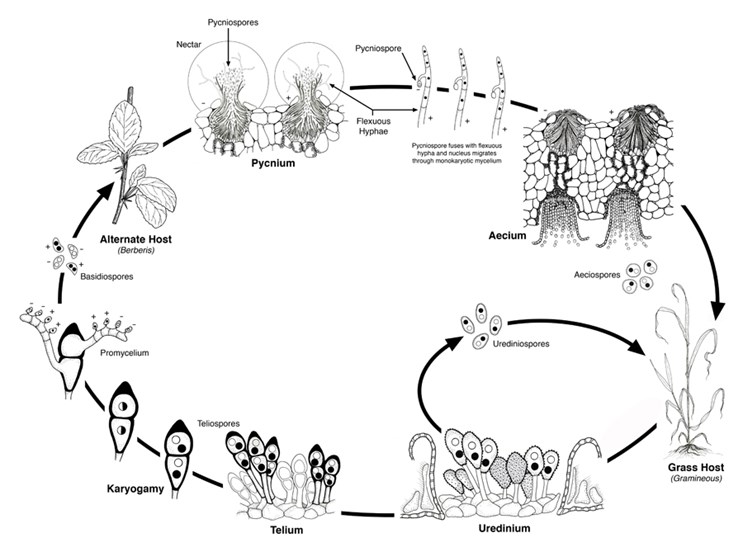
Source: ARS USDA

Source: APS
1. Urediniospores (Asexual Stage on Wheat)
- Urediniospores are the asexual spores that facilitate the rapid spread of the disease during the wheat-growing season.
- These spores are reddish-brown, oval-shaped, and produced in uredinia (pustules) on the leaves, stems, and leaf sheaths of infected wheat plants.
- Under optimal conditions (temperatures of 15-30°C and high humidity), urediniospores are dispersed by wind, infecting healthy wheat plants.
- Upon landing on a suitable host, they germinate, penetrate the plant tissue through stomata, and initiate infection, leading to the formation of new uredinia.
- Urediniospores can reproduce asexually and cause multiple infections in the same growing season, significantly contributing to disease severity.
2. Teliospores (Survival and Sexual Transition Stage on Wheat)
- As wheat plants mature toward the end of the growing season, the pathogen shifts from producing urediniospores to forming teliospores.
- Teliospores are thick-walled, dark brown to black spores that serve as sexual resting spores. They are formed in telia, which are the mature structures that develop on infected wheat.
- These teliospores enable the fungus to survive unfavorable conditions, such as winter, by remaining dormant in plant debris or soil.
- Within teliospores, a process called karyogamy occurs, where two haploid nuclei fuse to form a diploid nucleus, marking the initiation of the sexual phase of the life cycle.
3. Basidiospores (Sexual Reproduction Stage on Barberry)
- In the spring, under favorable conditions, teliospores germinate and undergo meiosis to produce basidiospores.
- These haploid spores are small, thin-walled, and are carried by wind. However, they are incapable of infecting wheat; instead, they are specialized for infecting the alternate host, barberry.
- When basidiospores land on young barberry leaves, they initiate infection, allowing the pathogen to switch from its primary host (wheat) to its alternate host.
4. Spermatia (Sexual Recombination on Barberry)
- On the upper surface of barberry leaves, the fungus produces structures called pycnia (now referred to as spermatia). These structures contain spermatia and receptive hyphae.
- Spermatia function in sexual reproduction and allow for genetic recombination. The transfer of spermatia from one pycnial structure to another occurs through rain splashes, wind, or insects.
- When spermatia meet receptive hyphae, fertilization occurs, leading to the formation of aecia on the underside of the barberry leaves.
5. Aeciospores (Infectious Stage on Wheat)
- Aecia develop on the barberry leaves and produce aeciospores, which are released into the environment.
- Aeciospores are dispersed by wind and are capable of infecting wheat, marking the start of the new infection cycle on the primary host.
- When aeciospores land on susceptible wheat plants, they germinate, leading to the establishment of new uredinia and the initiation of the next cycle of infection.
Management Practices for Black Rust of Wheat in Nepal
Black rust (stem rust) of wheat, caused by Puccinia graminis f. sp. tritici, poses a significant threat to wheat production in Nepal. The unique climatic conditions, combined with the widespread cultivation of susceptible wheat varieties, make effective management practices essential. Below are detailed best management practices specifically tailored to the Nepalese context, considering locally released varieties and registered pesticides.
1. Use of Resistant Varieties
Resistant Wheat Varieties: The adoption of resistant wheat varieties is one of the most effective strategies for managing black rust. In Nepal, several varieties have been developed and released by the Nepal Agricultural Research Council (NARC) that exhibit resistance to black rust:
- Borlaug 2020 – A high-yielding variety that has shown resistance to rust diseases.
- Zinc Gahun 1 and Zinc Gahun 2 – These varieties are bred for elevated levels of zinc and also exhibit resistance to black rust.
- Himganga – This variety has been specifically bred to withstand various stresses, including those from wheat rusts.
- Khumal-Shakti – Developed through collaborative efforts, this variety aims to provide better resistance against rust diseases.
- Bheri-Ganga – This is another variety released for its adaptability and resistance to environmental stresses, including black rust.
2. Cultural Practices
Crop Rotation: Implementing crop rotation with non-host crops (such as legumes or pulses) helps break the disease cycle. This practice can reduce the amount of Puccinia graminis inoculum available for wheat crops.
Field Hygiene: Maintaining good field hygiene by removing and destroying infected crop residues and volunteer wheat plants is crucial. This helps in minimizing the sources of infection for subsequent crops.
Timely Planting: Planting wheat at optimal times can help avoid peak periods of disease development. In Nepal, planting should ideally be done during the recommended window (October to November) to reduce exposure to high disease pressure.
3. Monitoring and Surveillance
Regular Scouting: Farmers should regularly inspect wheat fields for early signs of black rust. Visual identification of symptoms, such as dark, elongated pustules on leaves, can facilitate early intervention.
Disease Forecasting: Utilizing weather data and disease forecasting models can help predict black rust outbreaks, allowing farmers to take preventive measures before the disease establishes itself.
4. Chemical Control
Registered Pesticides: In Nepal, several fungicides are registered for use against black rust. Effective options include:
- Tebuconazole: A systemic fungicide that can control various wheat diseases, including black rust.
- Propiconazole: This fungicide has shown effectiveness against leaf rusts and black rust when applied preventively.
- Azoxystrobin: Known for its broad-spectrum activity, it can be effective when used as part of a fungicide rotation program.
Application Timing: Fungicides should be applied at the onset of symptoms or when disease levels are predicted to increase. A two-spray program, with applications at tillering and flag leaf emergence, is often recommended for effective control.
5. Integrated Pest Management (IPM)
Combining Practices: Implementing an Integrated Pest Management (IPM) approach that combines cultural, biological, and chemical practices is essential for sustainable management of black rust. This includes:
- Using resistant varieties.
- Maintaining field hygiene.
- Applying fungicides based on monitoring and forecasted disease pressure.
Collaboration with Agricultural Institutions: Farmers should work closely with local agricultural extension services to receive timely updates on disease management practices and the effectiveness of registered varieties and pesticides.
6. Education and Capacity Building
Training Programs: Organizing training sessions and workshops for farmers on black rust identification, management strategies, and the importance of using resistant varieties can empower them to implement effective control measures.
Extension Services: Strengthening agricultural extension services in rural areas will help disseminate knowledge and provide farmers with the latest research findings and recommendations for managing black rust.
Impact of Black Rust of Wheat on Wheat Production in Nepal
The impact of black rust (stem rust) on wheat production in Nepal is significant and multifaceted, affecting both yield and food security. Here are some key aspects of this impact:
1. Yield Loss
Black rust of wheat can cause severe yield losses in susceptible wheat varieties. According to reports, the disease can reduce wheat yields by up to 70% if left unmanaged(Far Eastern Agriculture)(CGIAR). This is particularly concerning in Nepal, where wheat is a staple crop and a primary food source for many communities.
2. Economic Impact
The economic consequences of black rust are profound, as reduced wheat production directly affects farmers’ incomes and livelihoods. Lower yields lead to increased food prices and can threaten food security, especially in rural areas where wheat constitutes a significant portion of the diet(ISAAA).
3. Threat to Food Security
Given that wheat is a staple food in Nepal, significant yield losses due to black rust can jeopardize food security. The rising prevalence of this disease, combined with the potential for new, more virulent strains (such as the Ug99 race), poses a serious threat to the country’s efforts to ensure adequate food supplies(ISAAA)(Far Eastern Agriculture).
4. Impact on Farming Practices
Farmers may be compelled to change their farming practices to manage black rust of wheat, including increased use of fungicides and the adoption of resistant wheat varieties. While these practices can mitigate losses, they also increase production costs and require access to knowledge and resources that not all farmers have(ISAAA)(CGIAR).
5. Research and Development
The threat of black rust has led to increased investment in research and development aimed at developing resistant wheat varieties and effective management practices. Organizations like the Nepal Agricultural Research Council (NARC) are actively engaged in breeding programs to enhance resistance to black rust of wheat(Far Eastern Agriculture)(ISAAA).
Conclusion
Black rust of wheat is a significant threat to Nepal’s wheat production, with implications for food security and rural livelihoods. An integrated approach combining resistant varieties, cultural practices, chemical control, and education can effectively manage this disease. As climate change continues to alter growing conditions, ongoing research and adaptation will be vital in safeguarding wheat production in Nepal.

Best knowledge about black rust